And we just submitted a proposal to look at clouds that have appeared in quasar spectra. We think the clouds are moving into and out of our line of sight. If approved, our recent proposal means we'll have looked at the leading and trailing sides of clouds, hence the title of this post...
Wednesday, October 3, 2012
Both Sides Now
PSU grad student Nur Filiz Ak led a project that watched clouds (of a sort) clear out from in between us and some distant black holes... cool to be part of that. http://www.sdss3.org/press/
And we just submitted a proposal to look at clouds that have appeared in quasar spectra. We think the clouds are moving into and out of our line of sight. If approved, our recent proposal means we'll have looked at the leading and trailing sides of clouds, hence the title of this post...
And we just submitted a proposal to look at clouds that have appeared in quasar spectra. We think the clouds are moving into and out of our line of sight. If approved, our recent proposal means we'll have looked at the leading and trailing sides of clouds, hence the title of this post...


Tuesday, October 2, 2012
Length of the Seasons, 2011-2012
Fun fact: because Earth's perihelion currently occurs in early January, it is moving faster in its orbit during northern hemisphere fall and winter. So the northern hemisphere currently gets a week more spring+summer than fall+winter.
---
Behold the math:
In 2011-2012, length of the northern hemisphere seasons in minutes:
winter:
Dec 22 05 30 to Dec 31 24 00 plus
Jan 01 00 00 to Mar 20 05 14: = (9*24+18.5)*60 + ((31+29+19)*24+(5+14/60.))*60
128144.
spring:
Mar 20 05 14 to Jun 20 23 09: = ((11+30+31+19)*24+(18+46/60.+23+9/60.))*60
133555.
summer:
Jun 20 23 09 to Sep 22 14 49: = ((10+31+31+21)*24+(0+51/60.+14+49/60.))*60
134860.
fall:
Sep 22 14 49 to Dec 21 11 12: = ((8+31+30+20)*24+(9+11/60.+11+12/60.))*60
129383.
ecl> =128144+129383-134860-133555
-10888
ecl> =10888/(24*60.)
7.5611111111111
sanity check:
=(128144+129383+134860+133555)/(24*60.)
365.2375
Astronomy Activities Manual
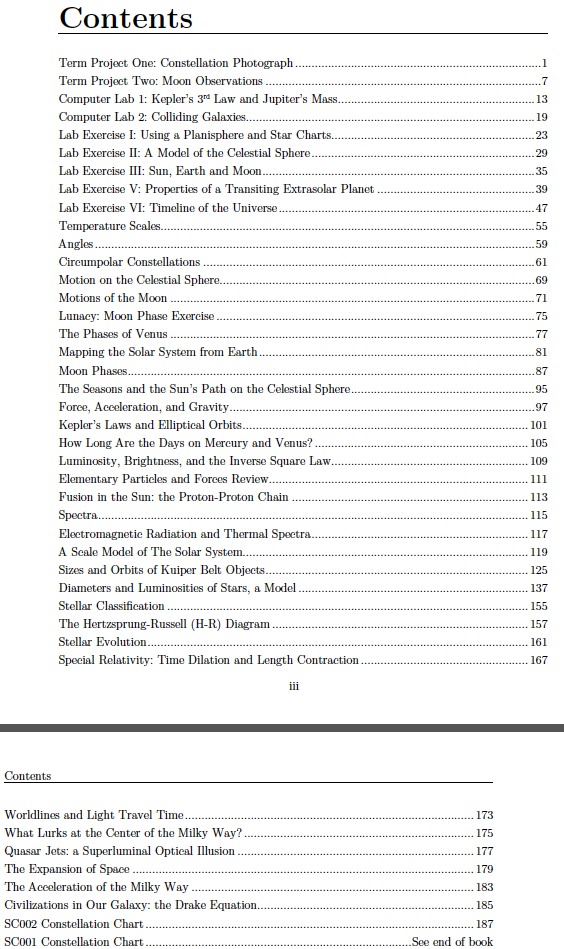
Last month saw the publication of my "Astronomy Activities Manual" from Kendall Hunt. If you're looking for in-class activities and a few lab exercises and assignments for students in your undergrad intro astro class, Kendall Hunt has published a wide of activities by numerous authors over the years. You can pick and choose the ones you like and put them together into a custom workbook (and the authors get royalties). I've taken existing activities that I think will work well in my class and added a dozen or so of my own, mostly for the extragalactic half of the course. If you're interested, check out the table of contents below and contact Richard Ludlow at Kendall Hunt (rludlow At kendallhunt.com) to get a sample copy. (PS - it's not a typo; there is no Lab IV in the book.)
Monday, September 24, 2012
Proposal Season
Kept waiting for this blog to resurrect itself, but blogger.com doesn't seem to have a self-writing option yet. To catch up: Over the summer I submitted one paper and my senior grad student & I submitted another. Plus my junior grad student & I started receiving the CFHT data for which we proposed in the spring. And a book of university-level astronomy in-class activities (half mine, half others) has been published. Right now I am working on telescope proposals, but should blog more often once they are in.
Thursday, April 19, 2012
Asteroid Pathall
A bunch of asteroids were discovered in the Sloan Digital Sky Survey, in which I was involved. So the asteroid scientists in the SDSS decided to name an asteroid after each of the several hundred scientists involved in the SDSS. It took a couple years, and I didn't want to say anything until it came through, but it finally did, and now I have an asteroid named after me.
You can see asteroid Pathall here. If you zoom in, you see a green, a red, and a blue image from upper left to lower right. Photos in those colors were taken about a minute apart, and because the asteroid is moving the images are offset from each other.
This asteroid hangs out beyond Mars, and is probably about 10 km on a side. It has an orbit with an eccentricity of 0.1491 (on a scale of 0 to 1), which is slightly disappointing; a more eccentric object would have been more appropriate to name after me, I think...
Wednesday, February 1, 2012
Back
Have been writing a lot of in-class activities for my intro astro course, testing them out in preparation for inclusion in an in-class activity workbook to be published next year through Kendall-Hunt. Was driven to change from the activity book I've used for the past 3 years because a significant # of students would bring the workbook to class but not fill it in, because they wanted to sell it back at the end of the year! So I told them I'm going to change workbooks next year, rendering sell-back difficult if not impossible. Kendall-Hunt has a lot of activity books from which to pick and choose activities to include in your own book, in addition to providing ones of your own (I find I have to provide the bulk of the stellar and extragalactic activities, as those are rather rare). Workbook will also include labs, like the new one on transiting extrasolar planets I just wrote.
Also am teaching an upper-division/graduate course on stars & nebulae.
Also am on a theory-faculty job search committee. 146 applicants! Ha ha I remember what having time for research used to be like.
Still, with last week's arrival of my postdoc Paola Rodriguez Hidalgo, it's time to bring research back into the mix. For example, I have an idea for using variability in BAL troughs to constrain the small-scale structure of quasar accretion disks...
Thursday, November 24, 2011
Teaching
As proof of non-slackage, I offer the following in-class activity developed for my intro astro for non-scientists class. Students work out the length of the solar days on Mercury and Venus using those planets' orbital periods and sidereal days. Usage in classes, comments, and suggestions are all welcome.
Subscribe to:
Posts (Atom)